Light Bench
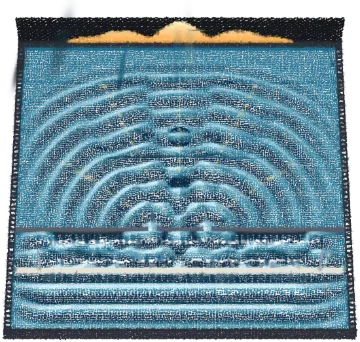
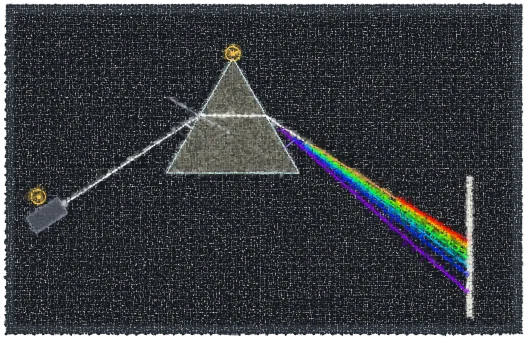
An optical bench: light traced as rays through real glass.
The facts
- Shelf
- Science
- Kind
- Built from a recipe
- Your own
- The numbers
- Sound
- Yes
- Licenses
- Own work (made in the page)
How to play, in the Playground
Drag a part to move it; turn it by its yellow knob. Tap to change the light. Numbers in the Splash tab.
Its controls
| Control | Kind | Range | Start |
|---|---|---|---|
| Change the light | Tap | ||
| Change the light | Button | ||
| Setup | List | 5 choices | Prism (white light into colors) |
| Lens (Lens and image) | List | 4 choices | Thin biconvex |
| Light | List | 4 choices | White light |
| Bend radius, light guide (cm) | Setting |
About it
An optical bench: light traced as rays through real glass. At every surface a ray bends by Snell's law, n₁ sin θ₁ = n₂ sin θ₂, or reflects, from a mirror or totally inside glass past the critical angle. Lenses have real spherical faces, so their edges focus a little off their middles, as real lenses do.
The glass is Schott N-BK7 (a crown glass) and N-SF11 (a dense flint), with their published Sellmeier formulas for how the index changes with wavelength. Glass bends blue more than red, so the prism fans white light into its colors. The light guide traps light by total internal reflection until a bend is too tight.
The Splash tab shows the angles, the lensmaker's focal length, the image distance from 1/f = 1/d_o + 1/d_i beside where the traced rays cross, and the prism's deviation for each color.
What it simplifies: the bench is flat, white light is nine wavelengths, and the weak reflections at glass surfaces are left out.
Details
- Splats
- Opens at 200,000 at Mid Detail, 56,592 at Low, and up to 200,000 at Max
- Turning
- Drag turns it left and right only, until Tilt lock is off
Is it right?
The light bench traces rays through real surfaces: at each one a ray bends by Snell's law or reflects, with the glass's refractive index from its published Sellmeier formula. The lens equation's image distance, the prism's deviation and a light guide's acceptance angle are checked against the traced rays. The bench is flat, white light is nine wavelengths, and the weak reflections at glass surfaces are left out.
Correct
Rays bend by Snell's law, n₁ sin θ₁ = n₂ sin θ₂, and reflect totally past the critical angle.1
Refraction uses the vector form of Snell's law; when it has no solution the ray reflects (total internal reflection).
Correct
The glass is Schott N-BK7 and N-SF11, with their published Sellmeier coefficients.23
n² − 1 = Σ Bᵢλ² / (λ² − Cᵢ), with the data sheets' six coefficients for each glass.
Correct
A lens's focal length follows the lensmaker's equation, and its image the lens equation 1/f = 1/d_o + 1/d_i.4
The bench prints f from the thick-lens lensmaker's equation and d_i from the lens equation (measured from the principal planes), beside where the traced rays from the object's foot, close to the axis, really cross.
Correct
A prism deviates light by δ = i + e − A, more for blue than for red, so white light fans out.5
The traced ray's change of direction is compared with the formula from Snell's law at each face, for two glasses, three angles and five wavelengths.
Correct
A concave mirror focuses a parallel beam at f = R / 2; a flat mirror reflects at the angle it was hit.6
Rays near the axis are traced off a circular mirror and their crossing with the axis is measured.
Correct
The light guide keeps light inside by total internal reflection, accepting rays up to the angle its numerical aperture gives.7
A core of N-SF11 in a cladding of N-BK7: the critical angle is arcsin(n₂/n₁) and the acceptance half angle arcsin(√(n₁² − n₂²)) in air; rays are traced into a straight guide at angles either side of it.
- 1Snell's law, Wikipedia
- 2N-BK7 (SCHOTT optical glass data sheets, 2017), RefractiveIndex.INFO
- 3N-SF11 (SCHOTT optical glass data sheets, 2017), RefractiveIndex.INFO
- 4Lens, Wikipedia
- 5Minimum deviation, Wikipedia
- 6Focal length, Wikipedia
- 7Numerical aperture, Wikipedia
- Simplified
- The bench is flat: rays travel in one plane, and lenses and mirrors are their cross sections.
- Simplified
- White light is drawn as nine wavelengths from 410 to 665 nm, and the colors on screen are approximations of the spectral colors.
- Simplified
- The weak reflections at each glass surface (about 4% for N-BK7 face on) are left out; only refraction, mirror reflection and total internal reflection are drawn.
- Simplified
- Air is taken as n = 1.
- Simplified
- The light guide is a thick glass rod with a high-index core (N-SF11 in N-BK7), much wider than a telecom fiber, so its rays can be seen; it works by the same total internal reflection.
Sources and credits
Made in Splashery. Its code is MIT.