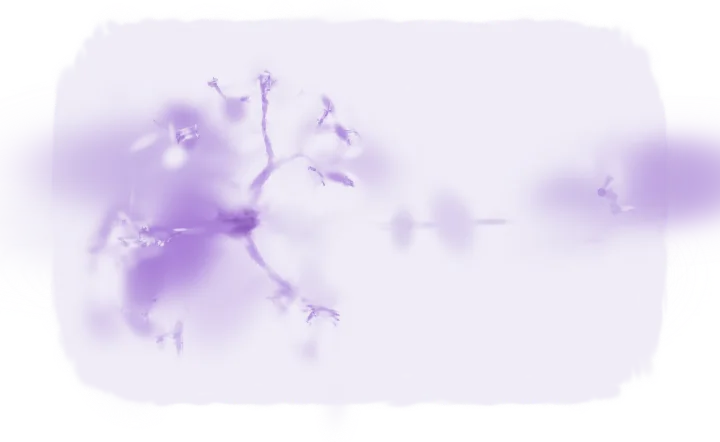
Neuron Specimen
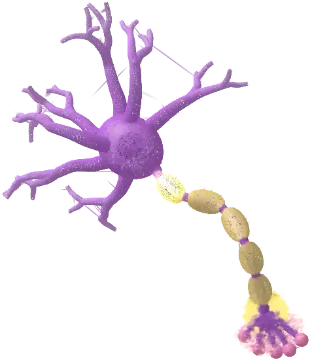
A textbook nerve cell on a lit microscope slide: dendrites, a cell body with its nucleus and Nissl bodies, a myelinated axon, and terminals.
The facts
- Shelf
- Tiny World
- Kind
- Built from a recipe
- Sound
- Yes
- Licenses
- CC0, MIT
How to play, in the Playground
Tap the cell to stimulate it there. In Splash, change the stain or turn Focus.
Its controls
| Control | Kind | Range | Start |
|---|---|---|---|
| Fire a spike | Tap | ||
| Focus | Slider | 0 to 100% | 100% |
| Fire a spike | Button | ||
| Stain | List | 3 choices | Nissl · cresyl violet |
About it
From a concept by Ryan Kamp. A textbook nerve cell on a lit microscope slide: dendrites, a cell body with its nucleus and Nissl bodies, a myelinated axon, and terminals. At full Focus, most screens draw 32,768 splats, low-memory phones 8,192.
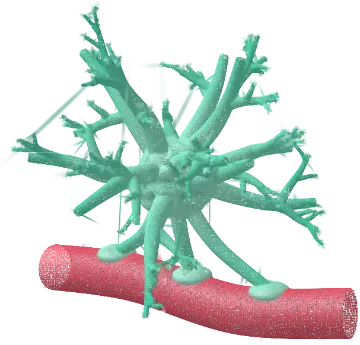
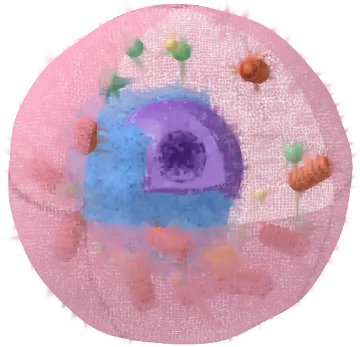
A tap is a stimulating electrode: the signal spreads through the dendrites to the cell body, which fires a spike down the axon, node to node. The waveform is the Hodgkin-Huxley squid axon model, slowed; this is a schematic, not a measured neuron. Nissl dyes the Nissl bodies and leaves the axon pale, Golgi turns the neuron black on amber, and H&E shows pink cytoplasm and blue-purple nuclei. Lower Focus: pairs of splats merge into one, keeping mass, center, and covariance, while the slide stays lit. Made by Ryan Kamp, CC0; code MIT.
Sources and credits
| Work | By | License |
|---|---|---|
| From a concept by Ryan Kamp. Procedural specimen made by Ryan Kamp; CC0. Code: MIT. | CC0, MIT | |
| Hodgkin-Huxley model (1952): squid giant axon; slowed for viewing. Stain colors follow textbook histology. The model is published science, not a licensed asset; the splash's simulation of it is Ryan Kamp's own procedural work. | CC0 1.0 |