What Splashery can do that other splat tools can't
SuperSplat, the editor from PlayCanvas, works on captured splat files: you crop, clean, and arrange a capture. Splashery draws with its own renderer and starts from the other end, because most of its Splashes are never captured at all. It also has one SuperSplat-like feature of its own: numbered, labeled points on a capture, called Labels (see What else Splashery does now). These are things we have not seen in other public splat tools. (We have not tried every tool, so read this as "to our knowledge".) The site has this list as a page too: What Splashery can do.
-
Splashes made from rules, in the browser. A recipe of a few kilobytes is built into
splats on your device. Its count is set for it at each Detail tier (about 200,000 at Mid
for most kit Splashes), and the Splats slider goes up to the Splash's own top, about
1,000,000 for a kit Splash. Those are the counts a Splash is asked for, not a count every
Splash draws. The shape itself is never a multi-megabyte file to download. (The page, the
engine, and any optional models or captures a Splash uses still download, and only when
that Splash opens.)
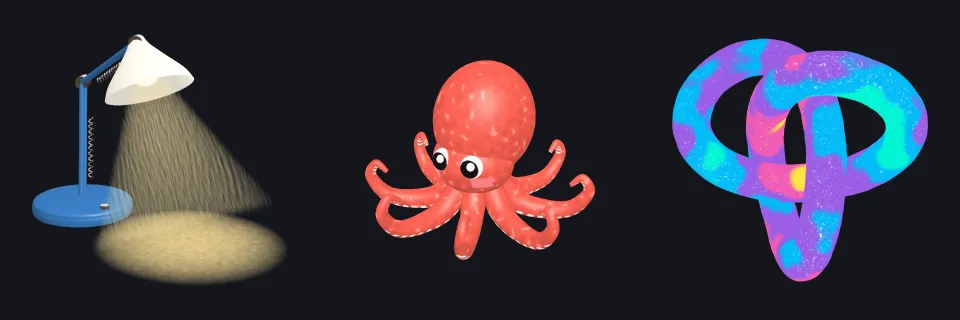
The Desk Lamp, the Octopus, and the Neon Knot, each built from its recipe on your device, not downloaded as a shape. -
Equations as a language. Type x, y, and z in
u, v, and t, and get an animated splat shape, with plain
messages instead of crashes (Chapter 3).
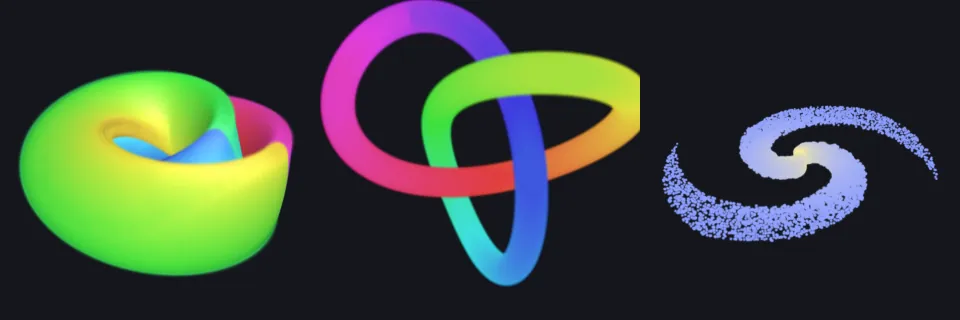
Three programs of the Splat Equation Splash: a Klein bottle, a trefoil knot, and a galaxy. -
Moving parts inside one splat cloud. Hinges, pivots, sliders, morphs, and per-splat
effects run on the graphics chip, so a chest opens and a windmill turns without rebuilding
anything (Chapter 2).
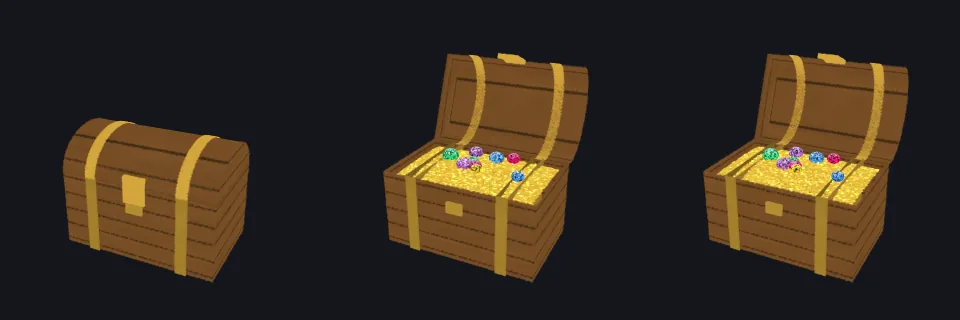
A chest opening on a hinge: one splat cloud, three moments. -
Hands-on physics on splats. Toss, stack, pull apart, and pour.
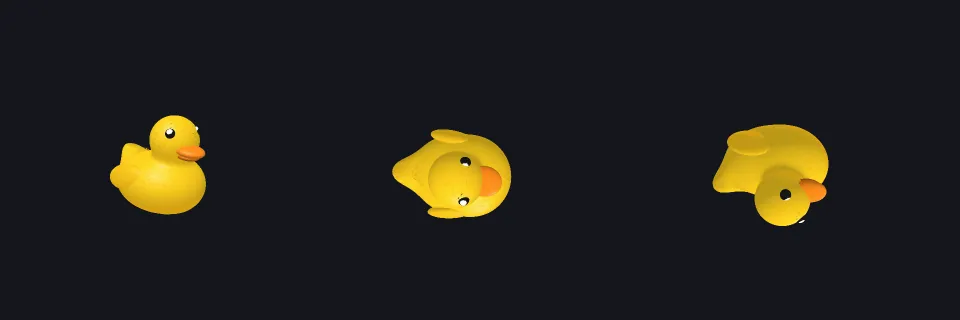
The Rubber Duck at rest, tossed, and tumbling. -
Almost anything, mostly as splats. Photos and videos with depth, PDFs, QR codes,
real science data, the night sky, and medical volumes. A photo opens in a sharp relief as
well as in splats, and Night Sky draws its sky, ground, stars, Moon, and Sun with meshes;
only its constellation lines, its tap ring, and its compass letters are splats.
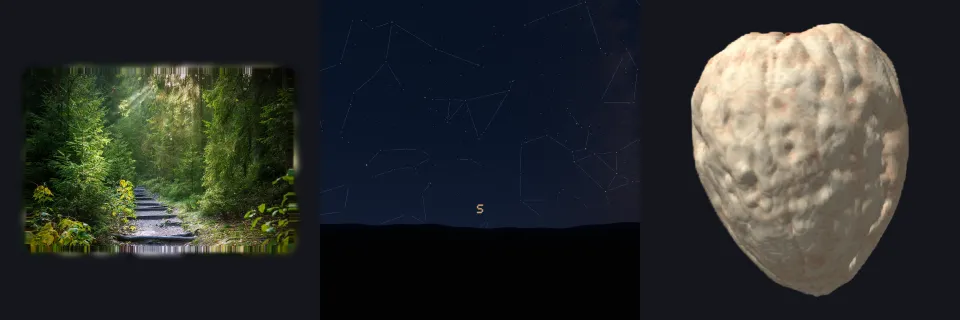
A photo, the night sky, and a scanned volume. -
A whole scene in a link. The
#s=links carry the Splashes, their options, and the camera. How they work:-
The scene is written as JSON, compressed with raw deflate, and written in base64url,
with a
d.in front (src/splashery/codec.js). Where a browser cannot compress, the link carriesj.and the same JSON, uncompressed but still in base64url, so it is not readable as plain text. Share links and QR codes explains the whole path. - A link carries settings, not your files. A photo or a splat file from your device has to be opened again by whoever opens the link.
- No server is involved. The link is the whole scene.
A tiny scene (a cactus and a camera), taken through the real link code, stage by stage. -
The scene is written as JSON, compressed with raw deflate, and written in base64url,
with a